

Beyond the Classroom: How an Industrial Visit to ABB Is Redefining Real-World Learning for BGSCET MBA Students
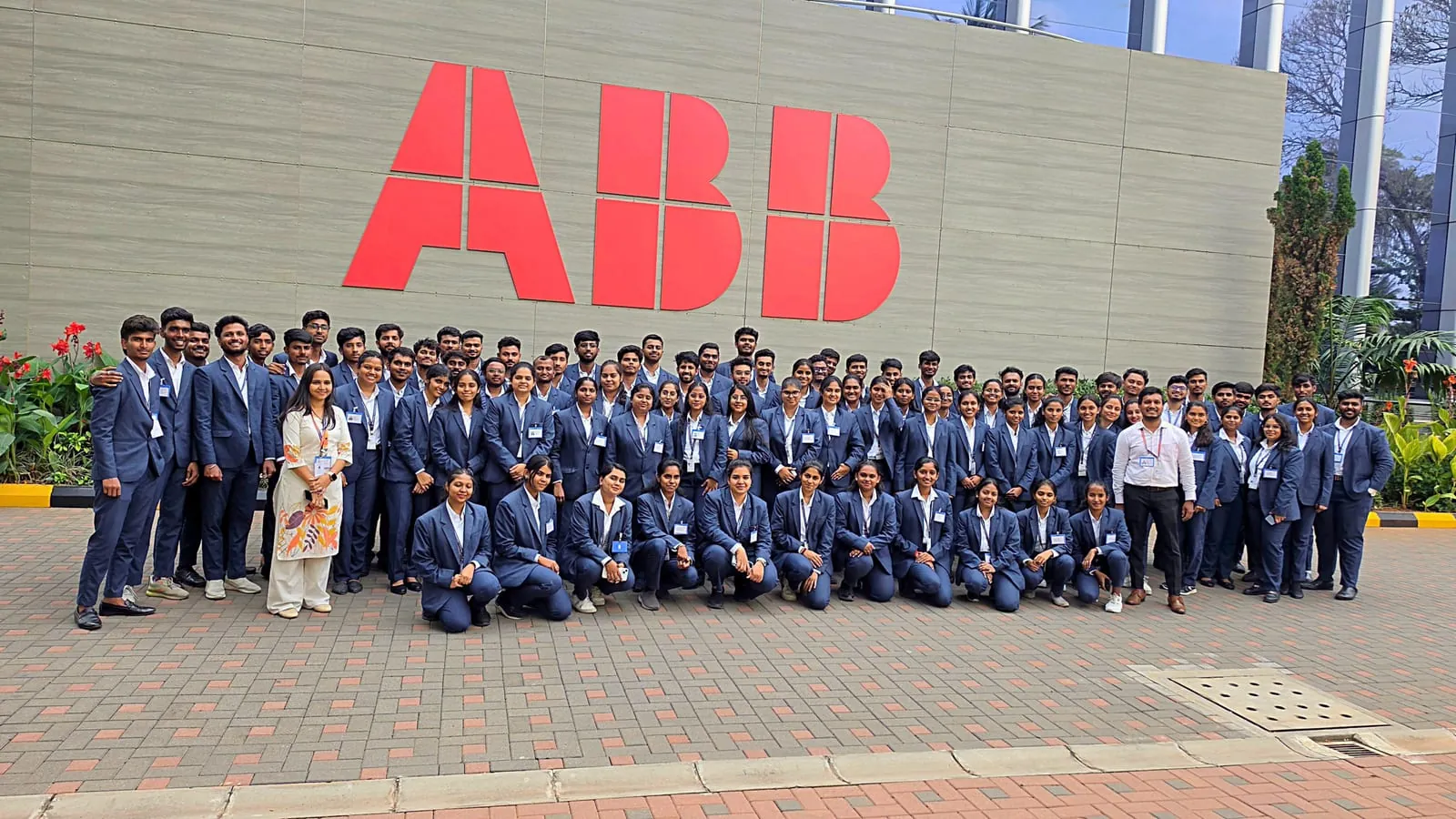
Why experiential learning through industrial visits is becoming the cornerstone of a future-ready MBA education in Bangalore.
For every aspiring management professional, the MBA classroom builds the foundation — frameworks, case studies, financial models, and theories of leadership. But true business acumen is forged the moment theory meets reality. This is precisely the philosophy driving BGSCET MBA's commitment to experiential learning, recently exemplified by a first-year student's industrial visit to ABB India Limited, a global leader in electrification, robotics, and industrial automation, at Peenya Industrial Area, Bangalore.
This visit was not a routine excursion. It was a carefully designed extension of the curriculum, aimed at helping students bridge the gap between academic concepts and the operational realities of a Fortune-listed multinational. For an institute that prides itself on industry-aligned management education, the ABB visit stands as a compelling case study in why MBA programs with strong industry exposure consistently outperform purely classroom-based learning models.
Operations Management: From Theory to the Factory Floor
One of the most valuable takeaways from the visit was a tangible understanding of how operations management functions inside a large-scale manufacturing enterprise. Students observed first-hand how ABB orchestrates a complex, interconnected chain of activities — procurement, production planning, quality assurance, dispatch, and customer support — all functioning as a single, synchronized system.
This exposure illustrated a principle that textbooks often simplify: a delay anywhere in the value chain creates a ripple effect across the entire organization. Procurement bottlenecks slow production; production delays compromise delivery timelines; and missed deliveries erode customer trust and revenue. For MBA students specializing in operations, supply chain, or general management, witnessing this interdependence in a live industrial setting offers insights that no case study can fully replicate.
Technology, Automation, and the Human Factor
ABB's facility also offered a masterclass in how automation and skilled human capital must work in tandem. Students witnessed the manufacturing of large transformers and power panels, supported by precision testing equipment designed to guarantee consistent quality at scale. The takeaway was clear: automation is not simply about speed — it is a strategic investment in reliability, consistency, and long-term competitiveness.
Equally important was the realization that even in a highly mechanized environment, technology is only as effective as the people operating it. Engineers, technicians, and supervisors remain indispensable to translating machine capability into business outcomes — a critical lesson for future managers who will be expected to lead technology-driven teams.
Understanding Industry Positioning and Global-Local Dynamics
A particularly enriching segment of the visit involved a discussion led by a senior ABB manager on how the company positions itself within a competitive global landscape. Rather than competing purely on price, ABB has built its market leadership on quality, innovation, and decades of trust — a strategic lesson directly relevant to MBA coursework in marketing, strategy, and brand management.
Students also gained insight into how decisions made at ABB's global headquarters cascade down to influence operations in India, underscoring the importance of understanding both local execution and global strategic alignment. This is the kind of nuanced, real-world business intelligence that distinguishes a truly industry-integrated MBA program from a conventional one.
ESG in Action: Sustainability as a Living Business Practice
Perhaps the most resonant component of the visit was the first-hand exposure to Environmental, Social, and Governance (ESG) practices — a subject increasingly central to modern MBA curricula. At ABB, ESG was not a slide in a presentation deck; it was a measurable, operational reality.
Textbooks can explain concepts, but only direct exposure to functioning enterprises can transform that knowledge into intuition.
On the environmental front, students observed ABB's investments in solar energy, responsible waste management, and energy-efficient product lines such as smart grid solutions and transformers designed to reduce customer-side electricity consumption. Tangible metrics — energy savings and reductions in carbon emissions — brought abstract sustainability commitments into sharp, credible focus.
On the social dimension, workplace safety emerged as a deeply embedded culture rather than a compliance checkbox, reflected in consistent training programs and visible employee confidence on the shop floor. On governance, the company's emphasis on ethical conduct, transparent reporting, and accountability illustrated how strong governance frameworks build long-term trust among investors, customers, and the public. For MBA students entering a business world where ESG performance increasingly determines investor confidence, regulatory compliance, and brand reputation, this exposure was both timely and invaluable.
Why This Matters for Prospective MBA Aspirants in Bangalore
Industrial visits of this caliber are a defining differentiator for MBA colleges in Bangalore that prioritize practical, industry-aligned learning over rote academic instruction. Bangalore's unique position as a hub for manufacturing, technology, and multinational enterprises gives institutes like BGSCET MBA unmatched access to organizations such as ABB — turning the city itself into an extended classroom.
For prospective students evaluating MBA programs, this is a critical factor to weigh: does the curriculum simply teach business theory, or does it actively immerse students in the operational, strategic, and sustainability challenges that real companies face daily? At BGSCET MBA, the answer is unambiguous. Industrial visits, guest lectures from industry leaders, and live exposure to operational excellence are deliberately woven into the academic journey to produce graduates who are not just degree-holders, but decision-ready professionals.
Conclusion: Where Classroom Learning Becomes Real-World Mastery
The ABB industrial visit reaffirms a fundamental truth about modern management education: textbooks can explain concepts, but only direct exposure to functioning enterprises can transform that knowledge into intuition. From operations management and automation to global business strategy and ESG practices, this visit equipped BGSCET MBA students with insights that will serve them well beyond the classroom and into their careers as future business leaders.